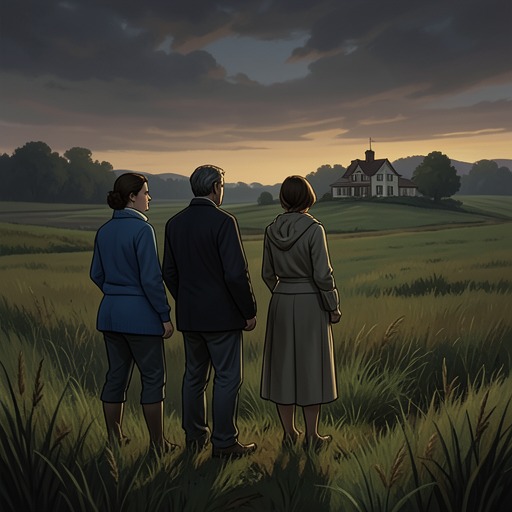
Paige Walker’s sixteen-year absence
The Sky Is EverywherePaige Walker’s sixteen-year absence is the defining condition of her daughters’ relationship with a mother they cannot know: she leaves when Lennie Walker is one year old, and does not return during the sixteen years that follow. The family makes her departure intelligible through a story of inherited restlessness and eventual homecoming, but that story cannot erase the lived fact of abandonment. Its meaning changes as Lennie discovers fragments of Paige’s ordinary life and, finally, learns what Gram said on the night Paige left.
Departure and the Family Explanation
Paige’s absence begins with a decision to leave. Years later, Gram recounts that Paige came for a weekend visit, carrying a one-way plane ticket to a destination she would not name. She told Gram she did not feel she had what it took to be a mother. Gram urged her to stay and offered to help raise the girls, but Paige repeatedly asked what Gram would do if she went. The next morning, Paige was gone. Lennie was one; she and Bailey Walker grew up without their mother.
For the girls, the absence was explained through the Walker family’s so-called The restless gene, a tendency—said to affect the women especially—to move from town to town, continent to continent, and from one love to another before eventually returning home. Gram named her aunt Sylvie and a distant cousin Virginia as women who had wandered and later come back. She presented leaving and return as paired destinies, giving Paige’s disappearance a family pattern and keeping open the possibility that she would come back.
That explanation also framed what the girls did not know about their fathers: Gram said Paige’s restless life meant she did not know who either father was, and so neither did her daughters. Lennie later repeats the family account to Joe Fontaine, describing a mother she has never really known and the promise that Gram’s aunt returned after twenty years away. The story feels familiar to Lennie, but she admits that she is no longer sure how to believe in it without Bailey believing alongside her.
An Absent Mother Made Imaginary
For much of Lennie’s life, Paige exists less as a remembered person than as Gram’s account of an explorer. The image offers a way to imagine movement as adventure rather than rejection. Yet after Bailey’s death, Lennie’s thoughts about her mother intersect with grief: she wonders whether Paige knew that one of her daughters had died, and whether anything in Paige’s distant life had registered the loss. The absence is therefore not only a past departure; it is also the impossibility of knowing what Paige knows, feels, or might have done.
A more intimate version of Paige appears when Lennie finds a polished mahogany letter box among the stored things in the attic. A ring of galloping horses is engraved on its lid; inside are folded notes and letters on Gram’s mint-green stationery, addressed to Paige and marked with years. The envelopes are sealed. Their yearly accumulation reveals that Gram has continued writing to her absent daughter, even though Lennie and Bailey were not told about the letters.
Reading the notes gives Lennie small, concrete details in place of the distant explorer story. Paige loved lilacs so intensely that she slept in Gram’s garden during spring, and she made pesto with walnuts. These ordinary facts make Paige feel newly real to Lennie: not simply a woman who wanders the world, but a person who might sleep among flowers and prepare dinner. The discovery intensifies rather than resolves Lennie’s longing. A mother who can be imagined making pasta seems closer, and her decision to leave two young daughters becomes harder to understand.
As the days pass, the new details strip away the protective family myth for Lennie. She concludes that Paige abandoned her children and did not return; the restless-gene story no longer makes that choice seem less painful. In this reckoning, Lennie sees herself and Bailey as children left behind, rather than as daughters awaiting the return of an adventurous mother. The change is not new information about where Paige went, but a change in the meaning Lennie can give to her absence.
The Hidden Cause and Its Aftermath
Gram’s later confession revises the story again. She remembers the night Paige came to the kitchen in a long green dress, with lilacs in the vases because Gram expected her. Paige was distressed and said she could not manage motherhood; Gram tried to hold her and persuade her to stay. When Gram lost her temper, she told Paige that if she left, she could never come back and would be dead to the family. Gram then shut herself away in her art room. Paige was gone the next morning.
The confession reveals that the promise of Paige’s return had never been a guarantee. Gram had told the girls that Paige would come back, but her account of the departure shows that she herself had ordered Paige not to return. For sixteen years Gram kept that part of the story from them and carried the blame privately, while her reassuring explanation shielded Paige from blame in the girls’ hearts. Lennie recognizes that Gram had taken responsibility for a departure she did not control, even though her words had become part of the history between mother and daughters.
Lennie tells Gram that Paige’s decision to leave and not return was Paige’s choice, not Gram’s fault, regardless of what Gram said that night. Gram responds with relief, as if the burden she has held for sixteen years has finally been loosened. The exchange does not bring Paige back or settle what the daughters lost. It does, however, change the family’s understanding of who was responsible for the absence and allows Lennie and Gram to face that history without assigning Gram the power to undo it.
Significance
Paige’s absence persists across the novel as both a physical separation and a story the family repeatedly revises. The restless-gene explanation gives Lennie a hopeful framework, while the letters supply intimate details that make Paige more human and her abandonment more difficult to excuse. Gram’s confession then exposes the hidden conflict behind the promise of return. Each new account changes the emotional shape of the same sixteen years without changing their central fact: Paige remains absent.
For Lennie, the revelation arrives amid the larger work of grieving Bailey and growing into a future her sister cannot share. Her understanding of her mother cannot repair the lost relationship, just as learning Gram’s part cannot reverse the departure. Instead, the history becomes less mysterious and less governed by inherited myth. The absence remains unresolved, but Lennie can distinguish Paige’s choice from Gram’s guilt and begin to see her family’s past more clearly.